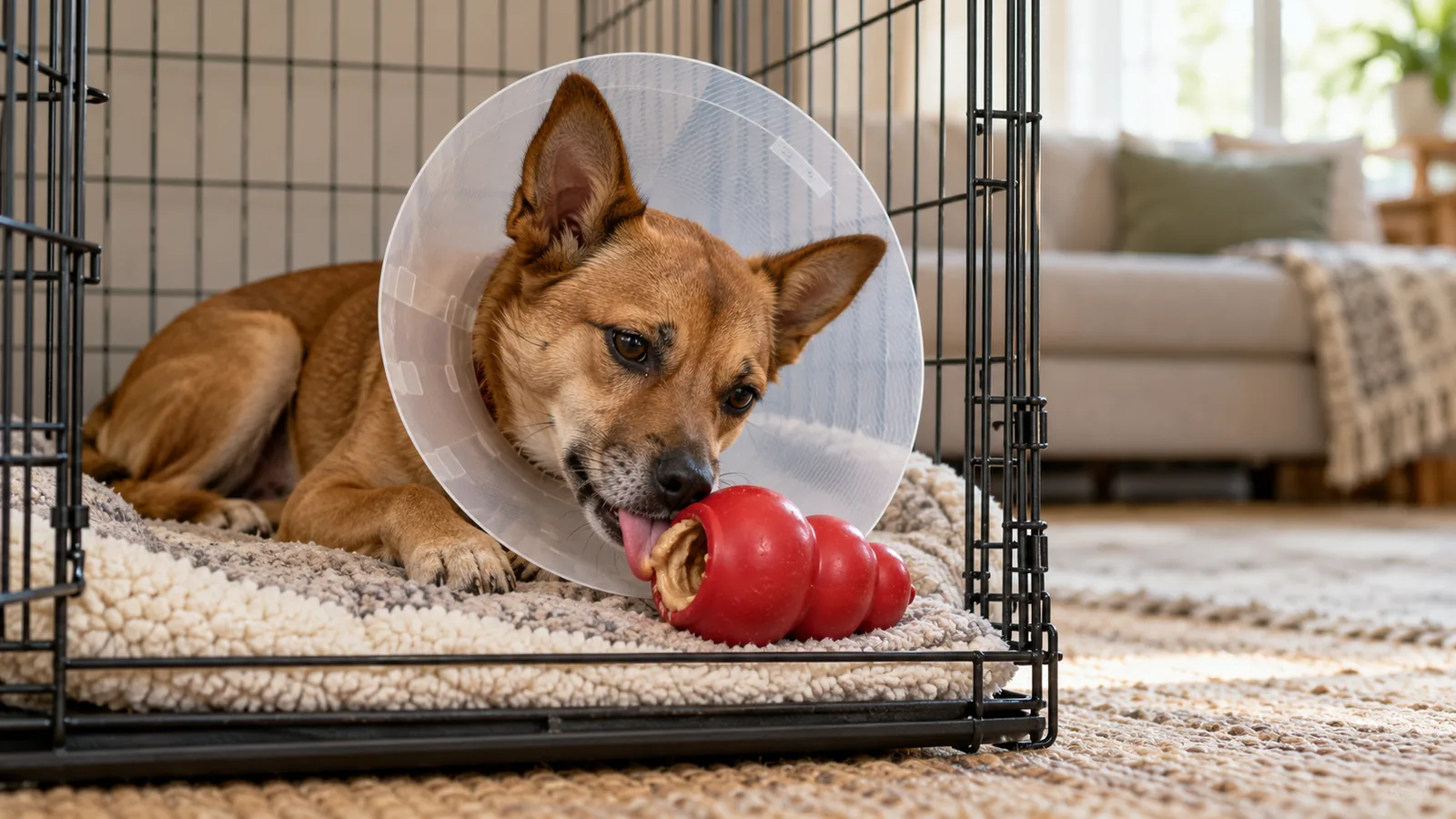
The hard part usually starts around day three, when your dog feels good again and there are still two or three weeks of restriction left on the discharge instructions. Incisions seal on the surface long before the tissue underneath has real strength, so a few minutes of licking or one hard landing off the couch can open a repair that was healing well. For a high-energy dog, the way through is trading physical outlets for mental ones: food puzzles and frozen stuffed toys in the kennel, scent work your dog can do lying down, short leash walks on a set schedule, and a rest spot away from the window and the front door. A dog who is mentally worn out settles, and settling for the full recovery window can be the difference between one surgery and two.
It is fair to be sick of the kennel by day four, when your dog is pacing at six in the morning and the whole house is short on sleep. Arcata Animal Hospital treats this stretch as part of the surgery rather than an afterthought, with rehabilitation and laser therapy for the days when your dog is healing but stiff and understimulated, and home exercise and massage programs you can do in the kennel instead of on a walk. Recheck visits at our AAHA-accredited hospital mean you are not deciding on your own whether a dog who will not hold still needs a different plan or a closer look at the incision. If the restrictions are coming apart at home or the incision looks different today than it did yesterday, call us before you wait it out.
Crate Rest After Surgery: What to Know First
- Skin that looks closed isn't healed underneath, so the restrictions on your discharge sheet run longer than the incision looks like it needs.
- Boredom is the biggest threat to a quiet recovery, and a dog who has worked their brain settles far better than one who has only rested.
- Food puzzles, lick mats, snuffle mats, nose games, and lying-down training tire a dog out without asking anything of the repair.
- Calming music, pheromones, and for some dogs anti-anxiety medication can carry a restless dog through a long recovery.
- Swelling that grows, cloudy discharge, a gap in the suture line, or a dog who can't settle even after a dose of pain medication are reasons to call us instead of waiting for the recheck.
Why Does My Dog Need a Cone and Crate Rest After Surgery?
The cone and crate rest both exist because a closed incision isn't a healed one. Licking pulls at sutures and pushes mouth bacteria into tissue that has no defenses yet, and one hard landing off the couch can separate a repair under skin that looks fine from the outside. Skin sutures usually come out around two weeks, but the tissue underneath keeps gaining strength well past that date, and orthopedic repairs can take four to six months to heal fully.
Good pain control is part of the reason the crate matters so much. A dog whose pain is well managed feels good, and that's exactly the point. It also takes away the soreness that would normally tell them to slow down, so a comfortable dog will happily jump, spin, and sprint on a repair that isn't ready. The limits have to come from the setup, because your dog can't self-regulate.
Cone alternatives like soft collars, inflatable donut collars, and recovery suits are fair game for some pets as long as the incision stays out of reach. The test for any of them is whether your dog's nose can reach the line. Ask us before trying an alternative; we get it, the cone is miserable for everyone, but it’s what keeps your pet safe.
How Can I Get My Dog Ready for a Crate Before Surgery?
If the surgery is planned, start crate practice a week or two ahead so the kennel feels like a familiar den instead of a new punishment on the worst week of your dog's life. Choose a crate that lets your dog stand, turn around, and lie flat on their side, but not much bigger, since extra room invites pacing.
- Size for the dog, not the space: Tall and giant breeds may do better in a small exercise pen, as long as it keeps them from running or jumping.
- Footing: A rubber-backed mat or thick bedding keeps a dog with a fresh orthopedic repair from slipping when they stand up.
Crate training can be hard, but it’s worth every moment for both you and your dog’s sanity. To build a good association, feed meals in the crate, toss treats inside, and close the door for a few seconds at a time, adding minutes as your dog stays relaxed.
What Can My Dog Do in the Crate That Won't Hurt the Repair?
Mental effort is real work for a dog. Sniffing, solving a food puzzle, and learning a new behavior all burn energy and lower stress, which is why a dog who has spent fifteen minutes on a puzzle often naps afterward. A dog on crate rest has lost the walks and runs that used to wear them out, so brain games fill the gap without asking anything of the repair. Low-impact enrichment is anything that tires the brain while the body stays still: licking, sniffing, chewing, and learning. Spread short sessions through the day, especially when your dog usually gets restless.
Which Food Puzzles Work in a Crate?
Feeding meals from a puzzle instead of a bowl turns a two-minute meal into twenty minutes of work your dog can do lying down. Most enrichment ideas for pets use things already in your kitchen or recycling bin, and these DIY enrichment projects are easy places to start:
- Muffin tin: Kibble in the cups with tennis balls on top, so your dog has to nose each ball out of the way.
- Rolled towel: Kibble scattered along a towel, then rolled up loosely for your dog to unroll.
- Egg carton or cardboard tube: Kibble inside, ends folded shut, for a dog who likes to rip.
- Ice cube tray: Low-sodium broth or a little wet food frozen into cubes for a slow, cool lick.
- Frozen stuffed toy: A rubber toy packed with soaked kibble and frozen overnight.
- Lick mat: A textured rubber mat, like a LickiMat, spread thin with wet food, plain yogurt, or plain canned pumpkin. Freezing it makes it last longer, and steady licking is soothing on its own.
Supervise anything made of cardboard, fabric, or soft rubber, and trade it out once it starts coming apart, since swallowed pieces are their own problem. Count puzzle food toward the day's meals instead of adding it on top.
Store-bought puzzle toys and treat dispensers come in difficulty levels, so you can move up as your dog catches on. For crate rest, choose puzzles that sit still. Treat balls and wobblers that have to be chased across the floor are better saved for after the recheck.
Can a Dog on Crate Rest Use a Snuffle Mat?
A snuffle mat is a rubber mat threaded with fleece strips, with kibble sprinkled down into the fabric so your dog has to sniff it out. It's one of the best crate-rest tools, because sniffing is calming and tiring and happens with the body still. You can make a snuffle mat from a rubber sink mat and strips of fleece.
Which Nose Games Can a Dog Play Lying Down?
Scent games tire a dog out quickly, and they settle an anxious dog as well as a bored one. Try these inside the pen:
- Shell game: A treat under one of three upturned cups. Shuffle slowly and let your dog nose the right one.
- Box search: A few cardboard boxes with a treat in one, so your dog sniffs from box to box without moving far.
- Scent trail on a towel: A few treats tucked into the folds of a blanket for your dog to find.
Keep finds within a step or two so nobody sprints, and skip any game that winds your dog up instead of settling them. Gentle enrichment ideas like these suit a small space.
Is Training a Good Idea During Crate Rest?
Yes. Learning is some of the most tiring work a dog does, and positive training builds confidence while the rest of their world is on hold. Stick with behaviors your dog can do lying down, such as a chin rest on your hand, a nose touch to your palm, eye contact on cue, or "settle" on a mat. Two or three sessions of a few minutes each beat one long one.
Recovery is also a good time to practice cooperative care, which means teaching your dog to take part in their own handling instead of just putting up with it. A dog who holds a chin rest while you look at the incision, or who pokes their head into the cone for a treat, makes every check, pill, and cone change easier.
What Should My Dog Chew?
Chewing is one of the few outlets a confined dog has left, and it's naturally calming. Safe chew toys are big enough that they can't be swallowed and soft enough to give a little under your thumb. Antlers, hooves, and cooked bones crack molars. Stick with easily digestible chews like collagen, bully sticks, frozen vegetables like carrots or celery, and VOHC-approved dental chews. Always supervise your dog with a chew and remove it when it’s small enough to swallow whole.
Do Calming Music, Pheromones, or Dog TV Help?
They help some dogs, and they're easy to try:
- Calming music and audio: Studies in kenneled dogs link soft classical music and audiobooks to more resting and less barking. Switch playlists every few days so it doesn't fade into background noise.
- Pheromones: Dog-appeasing pheromone products copy a calming scent nursing mothers give off, and they come as plug-in diffusers, sprays, and collars. Spray bedding about 15 minutes before your dog goes in, never your dog directly.
- Dog TV: Nature footage or channels made for dogs settle some dogs. Turn it off if animals on screen get your dog barking.
How Do I Keep Crate Enrichment Safe After Surgery?
Start easy, rotate toys every couple of days, and avoid string, rubber bands, small parts, and anything with stuffing your dog can pull out. Keep tug, fetch, and anything that has your dog leaping or spinning off the list until the recheck, and use the table below as a quick checklist.
| Kennel activity | What it does for a confined dog | Keep an eye on |
| Frozen stuffed toy | Licking is self-soothing and outlasts any biscuit | Count it toward the day's food, and rinse it between fills |
| Snuffle mat | Sniffing brings arousal down and happens lying down | Wash it often, and pick it up if your dog starts chewing the fleece |
| "Find it" with three upturned cups | Scent work tires the brain with almost no movement | Run it inside the pen so there's no sprinting to the find |
| Lying-down training like chin rests and nose targets | Learning is tiring, and short sessions add up | Skip anything that has your dog popping up and down repeatedly |
What If My Dog Still Can't Settle in the Crate?
If your dog is still pacing, whining, or panting after puzzles and nose games, call us before trying anything new. A dog who is hurting, anxious, or simply bored can look exactly the same from the outside, and each one needs a different fix. We'll help you figure out which it is.
Is My Dog Bored, Anxious, or in Pain?
Dogs hide pain, so it often shows up as restlessness first. Panting at rest, a tucked posture, flinching when a hand comes near the line, leaving half their dinner, and pacing that gets worse just before the next dose is due are all common pet pain signs. Our veterinarians can check whether the pain plan needs adjusting before you add more enrichment to a dog who actually needs relief.
Can My Small Dog Get Outside During Crate Rest?
A pet backpack, sling, or stroller gets a small dog outside without taking a step. Clip the built-in tether to a harness, never to the collar, and keep a hand on your dog. A dog who feels good can launch out of a stroller or bag faster than you'd expect, and that jump is the exact landing crate rest is meant to prevent.
When Is Anti-Anxiety Medication the Right Call?
For some dogs, enrichment and calming aids aren't enough to get through four, eight, or twelve weeks of confinement. That isn't a training failure. Anxious dogs, young high-drive dogs, and dogs facing a long orthopedic recovery often need anti-anxiety or sedative medication to stay calm enough to heal. Some take a few weeks to reach full effect, so it helps to ask early. We'll pick a medication that works safely with your dog's pain plan, and you can refill it through our online pharmacy.
What Happens at a Post-Op Recheck, and When Can Rehab Start?
A recheck is a short appointment with a specific list behind it: swelling, redness, discharge, any gapping along the suture line, and whether pain control is still holding. When the exam raises a question the surface can't answer, in-house X-rays and ultrasound show what's happening underneath.
If you’re worried between visits, reach out; we’d rather hear from you and tell you everything is okay than have you wait and wonder.
Veterinary physical rehabilitation rebuilds the muscle and range of motion that weeks of confinement cost. When it begins depends on the procedure and on how the tissue looks, so it's a decision for the recheck rather than something to start on your own.
What Does My Dog's Recovery Plan Involve?
Your dog's recovery plan is three things running at once: pain medication on a schedule rather than when your dog looks sore, an incision you keep dry and check once a day, and activity held to the walks and footing your discharge sheet allows.
Pain control works better ahead of the discomfort than behind it, so finish the course as written even when your dog seems fine. Never give human pain medication. Ibuprofen and naproxen cause stomach ulcers and kidney damage in dogs, and acetaminophen damages the liver, at doses that sound far too small to matter.
Skip baths and swimming, and keep hydrogen peroxide, alcohol, and ointment off the incision unless we've told you otherwise.
What Families Ask Us During Crate Rest
Can the Cone Come Off at Night?
The cone stays on at night. Overnight is when quiet licking goes unnoticed, and a determined dog can do real damage in a couple of minutes while the house is asleep. Supervised breaks during the day are fine if your hands are free and your eyes are on them, with the cone back on before bed and any time you leave the room.
Can My Dog Do Food Puzzles With the Cone On?
Most dogs can, with a few adjustments. A cone blocks deep or narrow puzzles, so choose shallow ones like a snuffle mat, a lick mat, a muffin tin, or a rolled towel spread flat, and hold the puzzle at an angle your dog can reach. If your dog gets frustrated, make the puzzle easier rather than taking the cone off.
When Can We Get Back to Normal Walks and Off-Leash Time?
Normal walks and off-leash time depend on what was done, and a spay and a cruciate repair sit on very different timelines. Your recheck sets the schedule. Build back in steps, adding distance before speed, and save off-leash time and the dog park for last.
You Don't Have to Manage Crate Rest Alone
Cones and kennels aren't punishment. They're the part of the surgery that happens at your house. Your dog's pain control and activity limits were built at our AAHA-accredited practice around the procedure your dog had, and both can change if the first week isn't going the way it should.
If the incision looks different today, the restrictions have stopped working, or you'd feel better having someone look before the scheduled recheck, reach out to our Arcata team and we'll check the line, the pain plan, and whether the restrictions need to change.